
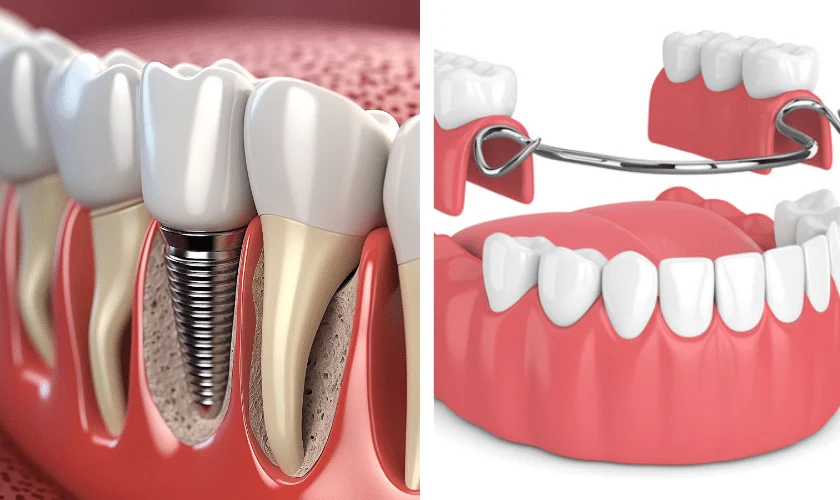
Important: Full-arch terms can vary between practices and manufacturers. Ask whether a proposed restoration is removable by you or fixed in place and removable only by a dental professional.
Start with the terms
A removable implant denture attaches to dental implants for support and can be taken out by the patient for cleaning. It is often called a snap-in denture or implant-retained overdenture.
A fixed full-arch restoration is secured to implants and stays in the mouth during daily life. Only a dental professional removes it when needed. Zirconia describes the restorative material used for the visible bridge, not the implants placed in the jaw.
Implant dentures and fixed zirconia arches compared
| Question | Removable implant denture | Fixed zirconia arch |
|---|---|---|
| Who removes it? | The patient removes it for routine cleaning. | It stays in place and is removed by a dental professional when needed. |
| How is it supported? | Attachments connect the denture to implants. | A fixed bridge is secured to multiple implants. |
| Daily cleaning | Clean the denture outside the mouth and clean around the implants and attachments. | Brush the restoration and clean around the implants and beneath the bridge as directed. |
| Stability | More stable than a conventional denture for many patients. | Fixed in place during eating, speaking, and daily care. |
| Ongoing maintenance | Attachments and the denture may need adjustment or replacement over time. | The bridge, screws, implants, and surrounding tissue require professional monitoring. |
Which option is easier to clean?
A removable implant denture can be taken out, which gives direct access to the denture, implants, and gum tissue. A fixed arch stays in place, so patients need to learn how to clean along the gumline and beneath the bridge with the tools recommended by their dental team.
Neither option is maintenance-free. Both require consistent home care and professional visits to check the implants, attachments or bridge, bite, and surrounding tissue.
What determines which option is possible?
Your treatment plan may consider:
- The amount and location of available bone
- Gum health and space for the restoration
- Your medical and dental history
- Tobacco use and other healing factors
- Your ability to clean and maintain the restoration
- Your preferences for removability, feel, appearance, and repair
- How the surgical and restorative phases will be coordinated
Some patients may also need extractions or bone grafting. An exam and imaging are needed before a recommendation can be made.
Why does cost vary?
Fees depend on the number and condition of remaining teeth, imaging, extractions, grafting, the number and location of implants, temporary restorations, the final design, and follow-up care. Insurance benefits and financing are separate considerations.
Ask for a written treatment plan that identifies each phase and what is included. Dental Specialty of Houston also lists its current payment and financing options and accepted insurance information online.
How do you choose?
Choose the plan that fits your anatomy, health, cleaning ability, daily priorities, and long-term maintenance expectations. A fixed option is not automatically right for everyone, and a removable option is not automatically a compromise. The right discussion should compare the exact designs available for your case.
Ask one clarifying question
“Will I remove this restoration at home, or will it be fixed and removed only by the dental team?” The answer clears up much of the confusion around full-arch treatment names.
Explore the practice’s implant denture and fixed zirconia arch services before your consultation.
Compare Your Options
Bring your questions to a full-arch consultation.
Our Porter, TX team can explain the designs that may fit your case and the maintenance each one requires.
Sources and further reading
This article provides general educational information and does not replace instructions from your treating dental professional.